A Facing Brick at the facade of a pharmacy in Amsterdam named the "Eternal Yawner" made by Jim Forest.. It looks rather new to me, the image as the way it was made.
Posts tonen met het label gevelstenen. Alle posts tonen
maandag 4 november 2019
dinsdag 30 januari 2018
Gable
I noticed the gable above this shop in Amsterdam.
The plaque shows a shepherd with his flock represented in a dune-like landscape. The sculptor has been inspired by a number of sketches the painter "Nicolaas Berchem"(1620-1683).
Around 1910 a few buildings in this street were demolished and replaced by a post office with upstairs apartments. This early 18-century plaque was saved and bricked in the hall of the post-office. But when a cash-machine had to be placed in 1989 the plaque was not visible anymore. So it was replaced to the opposite of the street, visible for everyone passing by.
Linking to "Our World Tuesday"
Labels:
Amsterdam centrum,
gevelstenen,
Our World Tuesday
woensdag 25 oktober 2017
Hats shop
A house in Amsterdam dating from 1618. You can see the two "pothouses" at the right which I mentioned in my yesterday's post.
But the house has also a beautiful gable with the text "In the long hatter's workshop". The owner Jan Reiners and his craftsmen made here cones or cloches of felt and than hats The cloches are displayed on the facade. Linking to "Signs, signs2"
vrijdag 27 januari 2017
Blue Sky
A blue sky with a beautiful building at the Damrak in Amsterdam. It was built in 1886 by architect Van Looy as a bookstore in Neo-Renaissance style. The busts, masks and catrouches on the facade are referring to art and culture of the Golden Age.
On top is a relievo with an owl, the symbol of wisdom surrounded with bookstore related items.
The sculpted busts are of famous writers and artists as Rembrandt and Rubens.
The bookstore has unfortunately gone as many others and you probably has noticed that the top is packed with cheeses. It is now a cheese store and tasting room.....
Linking to "Skywatch Friday"
Labels:
Amsterdam centrum,
gevelstenen,
Oude gebouwen,
Skywatch Friday
dinsdag 27 december 2016
Unusually plaque
This plaque in 1997 made by the occupant of the poperty in Amsterdam, depicts the ancient name of the house. The name "Red Lion" may be related to the 18th-century Pub with the same name which was also located on the Brouwersgracht ( the Brewers canal). So it is not an original old restored plaque.
woensdag 7 december 2016
Dune view
A gable at the facade of a house at the "Zeedijk" in Amsterdam.
The text says "Duyn Sigt Anno 1725" ( Dune view 1725)
It was restored in 1996 and you can see a little house in the dunes and a man approaching from the left with a stick over his shoulder with two hanging rabits. Left and right in the dunes are other rabits running.
This is how it looked like before it was restored.
Linking to "Signs, signs"
woensdag 29 juni 2016
A Gable
A gable with an image of a Coffee Bag. An old photo at the Munipal Archives shows that the stone was originally wider and the date 1727, mentioned in the archives, has lost.
Ancient home papers did not reveal any link whatsoever with the Coffee Bag on the plaque and the builder or owner of the property, Jacobus Brugman, master tinsmith by profession.
The original house has been demolished in 1920 and the plaque has been replaced, after renovation, at another old building. Linking to "Signs, signs2"
woensdag 22 juni 2016
A Gable
A restored gable at a house in Amsterdam dating from 1742. In animal symbolism the ostrich is an example of "strenght through resistance" and the story is the ostrich can digest the stone and iron in his stomach. But with a stone or horseshoe in its beak, he is also a symbol of vigilance and alertness. The original house where the gable was placed has been demolished and it is replaced on a former bathhouse from 1924.
You can see it here at the far left side. Linking to "Signs, signs2"
woensdag 20 april 2016
A history
In 1482 here used to be a tower "Swych Utrecht" that was part of a medieval city wall defence complex in Amsterdam along the river Amstel. In 1882 the tower was demolished to make way for the "Doelen Hotel".
The gable in the facade of the hotel remembers how the former tower looked like.
Here an old image from internet of the medieval towercomplex.
Linking to "Signs, signs"
woensdag 2 maart 2016
Three deer
Warehouses along the Brewers canal in Amsterdam. The name comes from the many breweries that were here in the 16th and 17th centuries. The canal water was of very poor quality and could not be drunk. Therefore beer with a very low percentage of alcohol was used as drinking water.The brewers took their water with boats from the Haarlemmermeer, outside the city.
The warehouses are now largely converted into apartments.
I noticed the unusual three deer with large antlers on top of the buildings. The ornaments are reapplied in July 1992 after one of the residents of the in 1975 renovated apartment complex had seen them in old photographs. Because stone would be too heavy on the roof, an artist has modeled the deers from plastic on a brass frame.
The gable stone of the middle house has the text
"The Green Heart", a nature area in the heart of the country,
so probably that is the origin of the deers on top.
Linking to "Signs, signs"
Labels:
Amsterdam centrum,
gevelstenen,
grachten,
signs2
maandag 25 januari 2016
Monday Mural
A facade of an old Amsterdam house dating from 1729 with the text "De Wyn Bergh" ("The Wine Mountain"). As you might have guessed here is a wine liquor store located since a very long time.
Here a view of the complete house at the "Haarlemmerdijk".
Linking to "Monday Mural"
Labels:
Amsterdam centrum,
gevels,
gevelstenen,
Monday Mural
woensdag 13 januari 2016
Historic plaques
Two plaques at the facade in the Haarlemmerstreet in Amsterdam.
They both have the same name but with different orthography. They belonged to Jan Pietersz, a barge carrier from Langendijk a little village to the north of Amsterdam, who became burgher of Amsterdam in 1602. In 1631 he had built two houses at this place and his name was now Jan Pietersz. Langendijck.
The sculptor of the two plaques had some great imagination, the view at the village "Broek op Langendijk" is not very realistic, What village had four churches in those days and the orthography of the name of the village is also not correct at the second plaque.
In 2014 the houses were renovated and the plaques were restored and replaced as well.
Linking to Signs, signs.
woensdag 22 juli 2015
Resting Shepherd
The resting shepherd I saw at the facade of a building in the "Haarlemmerstreet" in Amsterdam. The date is unknown but the stone cutter was inspired by some drawings of the artist Nicolaas Berchem (1620-1683). The house where it was placed was demolished in 1910 but the gable was saved and replaced in a postoffice hall way. When in 1989 a cash machine was installed it vanished for a while but was recovered in 1995, restored and replaced on the facade of an appartmentbuilding across the street.
Linking to "Signs, signs"
woensdag 13 mei 2015
Gable
A striking gable with a tree on the facade of a house at the Vijzelgracht in Amsterdam. At a public auction on December 20 1762, Coenraad Essenberg, a Polish saddler, who became an Amsterdam citizin in 1748, buys a house and yard on the Vijzelgracht. Most likely he did shortly after buying the property, renew the facade and had affixed a plaque with a tree in full leaf standing on a mountain with the caption D.ESSE BOOM ( D. ESSE TREE) The image on the stone represents the name Essenberg (Essen mountain).
In 1881 the building was renovated into the current state. The gable was lost for a long time but found in 1933 in a stockroom in a poor condition.
The current occupant of the house strove to ensure the gable was restored and put back on the facade of his house which happened in 2013.
Linking to "Signs, signs"
woensdag 21 januari 2015
The Mermaid
This gable with a mermaid was originally placed on the facade of a house built in 1650 on the former firing ranches of the crossbow and longbow militias called the Crossbow alley. She rode the waves, combing her hair with a mirror in her hand. In the 20th Century the house was demolished but the plaque was retained and given a place on the new building. In a subsequent rebuilding the plaque got the current spot in the traverse wall.
Over the years the mermaid was quite polluted and had lost clarity. In 2008 she was given a solid cleanup and has been polychromed.
Linking to Signs, signs
dinsdag 17 juni 2014
Leopard
A plaque inmured in the facade of a a former school building at the Keizersgracht in Amsterdam. It had come from a demolished canal building from the 17th century and was found in 1957 in the art room of the school that was raised in 1930 at the same spot. It was replaced with the addition of the name of the old house in old dutch language "D Luypaert" (Leopard). In the times of the Dutch East India Company between 1602 and 1796, the trade ships often took some exotic animals home for private zoos of rich citizins.
woensdag 19 maart 2014
Looking up
Walking in Amsterdam, sometimes it's worth to look up. Then you can see some interesting decorations on the facades of the buildings.
I haven't found any information about the building or the decorations, only it is a a gay bar now.
zaterdag 22 februari 2014
Plaque
Here you have a better look of the image.
dinsdag 11 februari 2014
Almshouse van Brienen
A plaque at this building commemorates "Arnout Jan van Brienen, Heer van de Groote Lindt" and his wife "Sophia Maria van Wassenaer" who founded a almshouse for 40 poor homeless eldery people in 1804 at the Prinsengracht (canal) in Amsterdam. He was a very rich man and used his money at least to help the poor. Above the porch is an arm with two putto (a chubby male child) with a catholic cross).
Above the porch is a a nice little tower.
In september last year I visited the home of Van Brienen at Open Monuments day, look here.
Want to read more about this almshouse look here.
zaterdag 29 juni 2013
Pawnshop
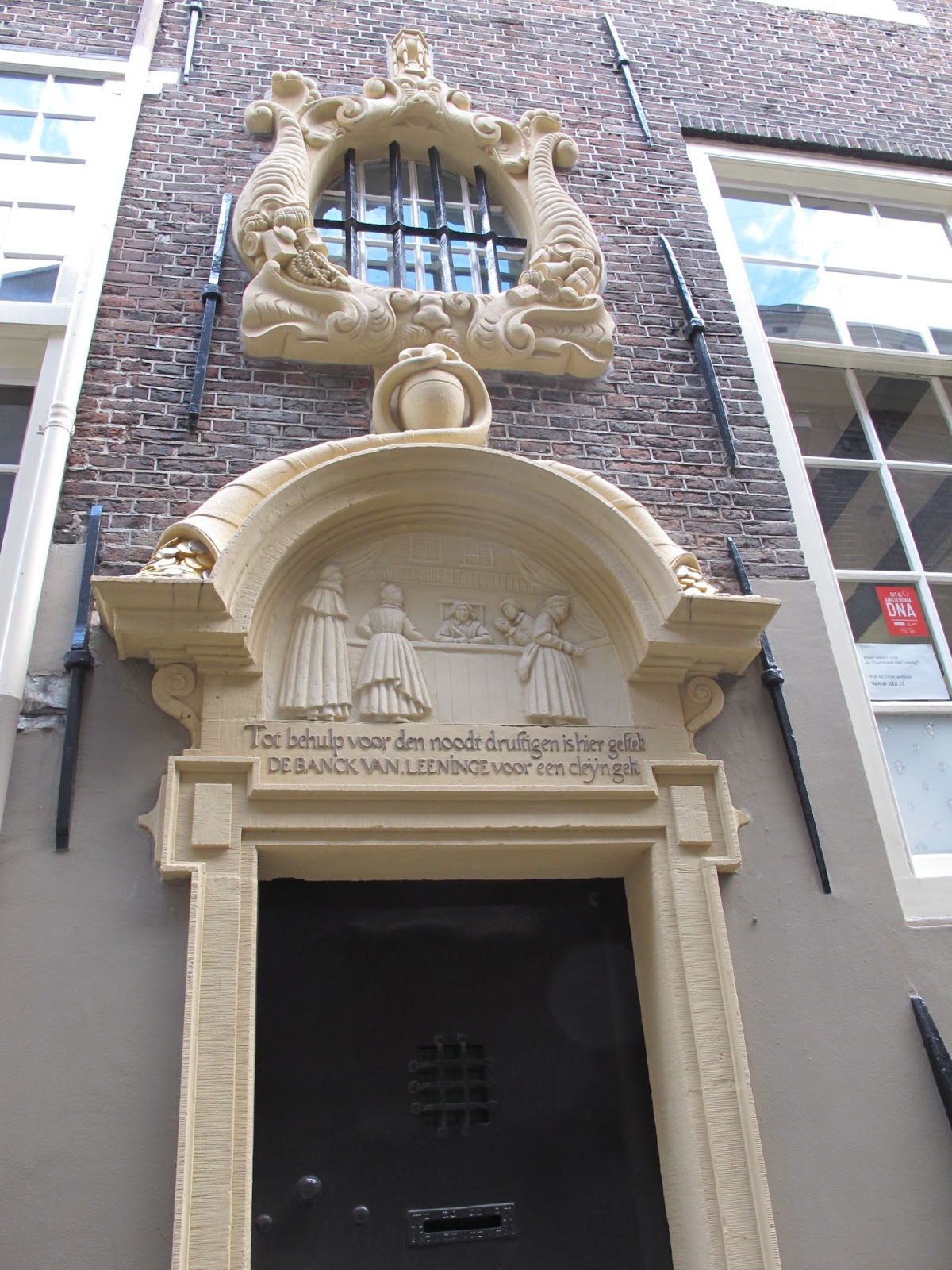
The pawnshop in Amsterdam has a beautiful restored facade with a phrase in old dutch "Tot behulp voor den noodtdruftigen is hier gestelt De BANK VAN LEENINGE voor een cleyn gelt".
Translated in english it says "To help the miserable ones, the pawnshop is there for a little money".
The pawnshop was founded in 1614 and is a municipal not-for-profit establishment. It is the oldest money donor of Amsterdam with six branches, two shops and an auction house.
And here you see the money rolling.
Abonneren op:
Posts (Atom)